In-House vs. Outsourced Customer Support: How to Decide
The real tradeoffs between building customer support in-house and outsourcing it, plus a simple framework for choosing the right model for your stage.
By Jesel Cura3 min read
At some point, every growing business hits the same wall: customer questions arrive faster than the team can answer them. Replies slow down, founders jump back into the inbox, and support quality starts to depend on who happens to be free.
The fix is dedicated support. The question is whether to build it in-house or outsource it. Both can work. The right choice depends on your stage, your volume, and how much of your team's time you want to spend managing support instead of doing it.
What in-house support gives you
Direct control. Your support team sits inside your company, absorbs your culture, and can be pulled into product conversations easily.
Deep product knowledge over time. People who live with your product every day become experts, especially for complex or technical products.
The tradeoffs: hiring takes time, and support hires need training, scheduling, management, and backup coverage for sick days and holidays. For a small team, one support hire can also become a single point of failure.
What outsourced support gives you
Speed to coverage. A good partner can have trained support in place far faster than a typical hiring process.
Structure you don't have to build. Escalation paths, saved replies, quality checks, and documentation come as part of the model instead of being invented from scratch.
Flexibility. Coverage can grow for launches and peak seasons without a permanent hire.
The tradeoffs: you need to invest in a clear handoff. Outsourced support is only as good as the information and rules it's given, and some very technical questions will always need your team.
At a glance
| In-house | Outsourced | |
|---|---|---|
| Time to coverage | Hiring and training time | Faster, with a partner's process |
| Structure | Built by you | Escalations, QA, and docs included |
| Flexibility | Fixed headcount | Scales for launches and peaks |
| Product depth | Grows over time | Depends on documentation |
| Management | Your team's time | Shared with the partner |
Questions that point to the right model
Work through these honestly:
- How complex are most customer questions? If most are order status, account access, returns, or how-to questions, they can be documented and delegated. If most need engineering, keep a stronger in-house layer.
- How spiky is your volume? Launches, sales, and seasonal peaks favor a flexible model.
- Who would manage an in-house hire? If the honest answer is "the founder, in spare time," outsourcing the structure as well as the work is usually the better deal.
- Is support a differentiator or a necessity? If white-glove support is your product, invest in-house. If it needs to be fast, accurate, and on-brand, a partner can deliver that.
The hybrid model most teams land on
For most growing businesses, the answer isn't either/or. A common pattern:
- Outsourced tier-one support handles the high-volume, well-documented questions across email, chat, and your help desk.
- Clear escalation rules route anything sensitive, such as refunds above a set amount, technical bugs, and upset VIP customers, to your team.
- An internal owner reviews trends, updates policies, and feeds recurring issues back into the product.
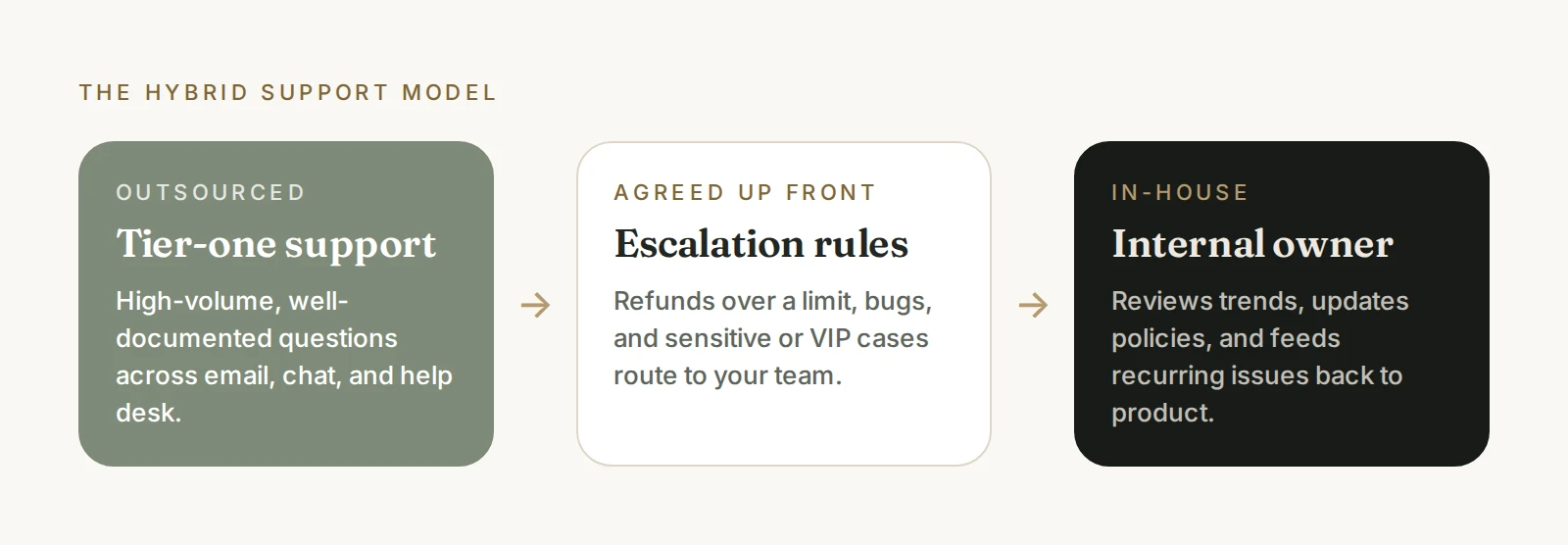
This keeps your team focused on the conversations that need them, while customers get fast, consistent answers to everything else.
Making outsourced support work
If you go the outsourced route, these steps make the difference:
- Document your answers. Turn your most common questions into saved replies and a short policy guide. If that feels daunting, start with SOP documentation.
- Define escalation rules up front. Write down what the support team can decide and what needs approval.
- Capture your tone. Share examples of replies you love so support sounds like you.
- Review early. Read replies closely in the first weeks and give direct feedback.
For e-commerce brands, the specifics matter: order edits, returns, and "where is my order?" make up much of the volume. We cover that in Shopify customer support.
Where SageStone fits
SageStone provides customer support outsourcing designed around this hybrid model: dedicated support embedded in your help desk, clear escalation paths, and oversight from SageStone so quality stays consistent as you grow. If you're weighing the options, book a discovery call and we'll help you decide what makes sense for your stage, even if that answer is to hire in-house.