A Customer Service QA Checklist for Growing Teams
A practical quality assurance checklist for customer support replies, covering accuracy, tone, resolution, and process, plus how to run QA reviews each week.
By Jesel Cura3 min read
Fast replies are only half of good customer support. The other half is consistency: every customer getting an accurate, on-brand answer, no matter who replied or how busy the week was.
That's what quality assurance (QA) is for. You don't need a large team or special software to start. You need a clear checklist and a regular habit of using it.
Why QA matters as support grows
When one person answers every ticket, quality lives in their head. As soon as a second person, a new hire, or an outsourced team joins, you need a shared definition of a good reply. Without one:
- Customers get different answers to the same question.
- Tone drifts away from your brand.
- Small mistakes repeat because nobody notices the pattern.
A QA checklist turns "good support" into something everyone can see and improve.
The customer service QA checklist
Score each reviewed ticket against these points. A simple yes / partly / no works well.
Accuracy
- The answer is factually correct and matches current policy.
- Order, account, or product details were checked, not assumed.
- Any links or instructions work and are up to date.
Resolution
- The customer's actual question was answered, not just acknowledged.
- The reply resolves the issue or clearly explains the next step and timing.
- Anything that needed escalation was escalated through the right path.
Tone and brand voice
- The reply sounds like your brand: warm, clear, and human.
- The customer's name and context were used naturally.
- Frustration was acknowledged without being defensive.
Clarity
- The reply is easy to scan, with short paragraphs and clear steps.
- No internal jargon or unexplained abbreviations.
- The customer knows exactly what happens next.
Process
- The ticket was tagged and categorized correctly.
- Internal notes capture what was done and why.
- Saved replies were used where they fit, and personalized.
- Response time met the target for that channel.
How to run QA each week
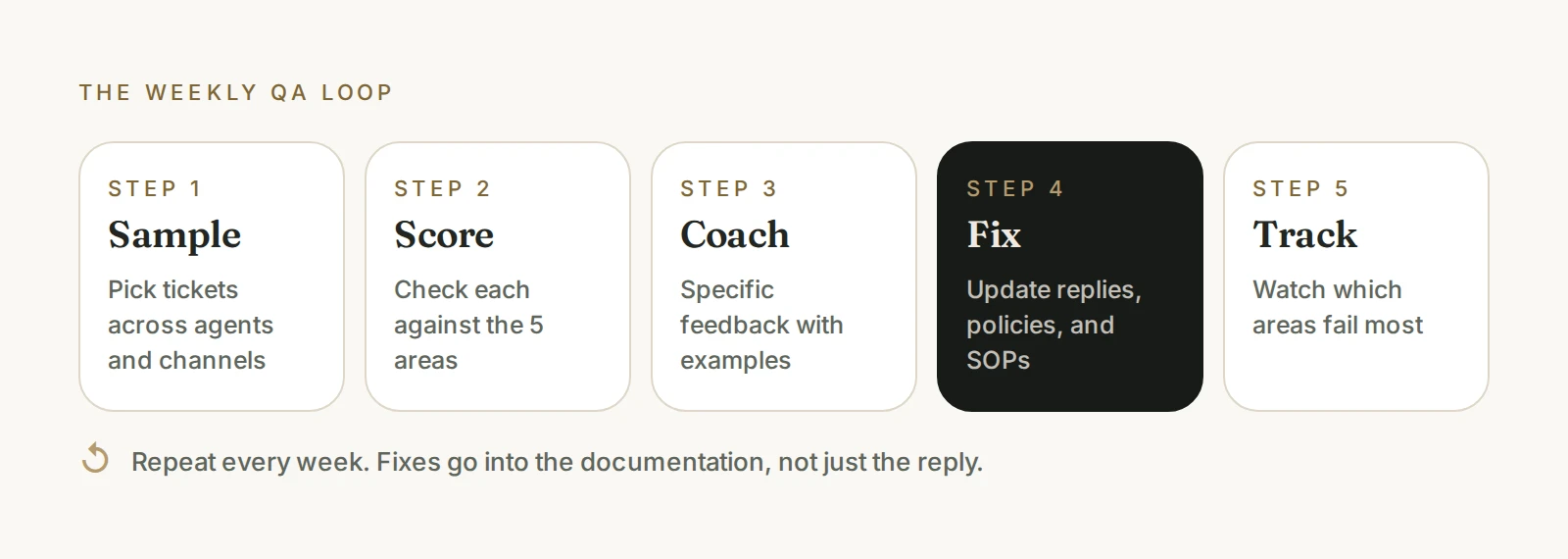
- Sample tickets. Review a set number each week across agents and channels. Include a few difficult conversations, not just easy ones.
- Score against the checklist. Keep it quick. The goal is patterns, not perfection.
- Share specific feedback. Pair each note with an example: what worked, what to change, and a better version.
- Fix the system, not just the reply. If the same issue appears repeatedly, update the saved reply, the policy note, or the SOP.
- Track trends. Watch which checklist items fail most often over time.
Turn findings into better documentation
The biggest value of QA isn't catching mistakes. It's finding gaps in how support is set up. A recurring error usually means:
- A policy is unclear or undocumented.
- A saved reply is outdated.
- An escalation rule is missing.
Each of those is fixed once, in the documentation, rather than corrected ticket by ticket. If your support knowledge isn't written down yet, start with SOP documentation.
QA when support is outsourced
QA matters even more when support is handled by a partner. It gives you visibility and keeps quality aligned with your brand. Agree up front on:
- The checklist used to review replies
- How often reviews happen and who sees the results
- How feedback turns into updated saved replies and SOPs
We cover the bigger decision in in-house vs. outsourced customer support.
How SageStone approaches support quality
Every SageStone customer support outsourcing engagement includes oversight: documented answers, clear escalation paths, and regular review so replies stay consistent as volume grows. If you'd like help setting up QA for your team, book a discovery call.